Showing posts with label Twitter API. Show all posts

01 March 2011

What Is and What Should Never Be

Happy Twitterversary.
Today marks the one year anniversary of Sean Garrett’s tenure as a Vice President of Communications. I was hoping to be a part of his team by now, but I’ve yet to make that a reality. It seems not-so-long-ago when friends were sharing open positions at a little start up in SOMA called Twitter. One offer was for a “Founder Associate.” Another was for a “Communications Associate.”

“Twitter is defining a new form of communication that is touching people’s lives across the world. We are small but well-funded and building a company to last. We are currently a team of 25 and looking for a few key people who will help take us to the next level.”
Twitter Founder Associate Job Description- Jobscore, 16 March 2009

Both positions seemed exciting, new, and unknown, but I was happy where I was, and had no reason to leave. I was already using Twitter—a lot. I was even using it in my job. And even though I was a tireless advocate of its uses, potential, and evolution as a new communications platform, working there never seemed to make sense. All that changed once It's power to do good started to become more apparent to me.

It’s no secret that when I first moved out to California my goal was to join the forces of good at Google.org. But as their priorities changed, I found myself looking for somewhere else to aim my corporate social responsibility ambitions. I was working for the Intel Education Foundation, but I knew that their focus—and funding—was limited. I longed to find a place to make a greater impact.

Other jobs have come and gone, most with non-profits, and some simply to fund an increasingly more expensive San Francisco existence, but I still feel driven to put my knowledge to use helping others. That doesn’t mean that Twitter’s recent rejection of my advances to join the flock hurts any less; it just means that I need to fine-tune my focus for getting in the door. So my new aim is to harness my interests to bridge the gaps between Twitter’s Communication, Media, and Philanthropic teams.

The details of my focus, what I can offer, and the strategy for getting there are still emerging. But they all start with finishing the application I have been trying to build on the Twitter API for the last few months. Harnessing information and redirecting it into action remains my new creation’s goal. As we’ve seen in northern Africa, information is at its most meaningful when it’s acted upon. So I hope to create an end product which will make that divide much smaller.

As usual, I’ll keep you updated on things as they progress. And I’m sure I’ll post a distraction or two about Twitter news in the meanwhile. But I’ll keep building. And writing. And trying to join the flock, while looking for you on the ‘morrow, on the Web.

10 January 2011

Transparency on Twitter

We regret the error.
This blog focuses primarily on Twitter. But one of my bailiwicks from a past life is journalism. And while I’ve created blogs primarily devoted to the vagaries of reporting news to audiences who may—or may—not care, those have long since been put to bed. Every now and then, however, I’ll notice some news coverage which gets my dander up. This weekend’s reporting of the shooting in Tucson is the latest example.

On Sunday, I was watching “This Week” from ABC News. The episode included a piece from Pierre Thomas about the alleged shooter, Jared Lee Loughner. In an ten minute profile, one of the still images of Mr. Loughner included a caption with his name spelled incorrectly.

Not “Jarod Lee Loffner.”

Now, I understand reporting errors occur every day; this very post might even have one. But multi-million dollar news organizations should make very few of them, especially when they are devoting so many of their resources to following such a potential ratings bonanza. What’s more important to me, however, is what they do when they discover an error.

That’s why I found a discussion on a recent “On the Media” so interesting. The segment featured a conversation between co-host Bob Garfield and Craig Silverman of Regret the Error about how news organizations handle corrections, if at all. It was surprising to me how many media outlets devote so few resources to updates of erroneous stories.

“... at places like CNN and FOX News and other large broadcasters there was either very little or nothing at all when it came to error reporting mechanisms.”
Craig Silverman- “On the Media,” 24 December 2010


Coincidently, I noticed a conversation on Twitter about a very similar topic. Prompted after the Poynter Institute posted a story calling Twitter an “imperfect news channel,” the discussion (which is embedded below) included recommendations about how newsrooms could signify corrected and amended information in updates.


Correcting conversation. 
Later, ABC World News promoted a story from Monday‘s broadcast, but misspelled the name of Mr. Loughner. I sent a reply, they corrected the mistake in a new update, but made no mention that it was correcting an error. They also deleted the incorrect update. It was minor, but was it transparent?

If we are going to continue to trust news agencies online as much as we do in broadcasts, they are obliged to find a more open way to correct and notify audiences of previous mistakes. Until they do, they are missing an important part of the transparency good reporting, and journalism in general, requires.

With that off my chest, I’ll get back to building with the Twitter API, and tell you about it on the ‘morrow, on the Web.

27 December 2010

A Tweet Falls in the Woods

A Twee in the woods.
I’m in the middle of a national forrest, with very little Web access, so this is just a short note to point you to a couple of quick items. First, one of my favorite tech journalists, Marshall Kirkpatrick, has an interesting story about an anonymous Twitter account doing some fun music reviews ... which the Village Voice just named it “Music Critic of the Year.”

Next, Liz Gannes at All Things Digital sums up some info I’ve already covered: Twitter’s increased funding and three-fold growth of employees—including the addition of Fluther’s team. What’s interesting is her perspective on how this new capital and talent acquisition will help bring greater relevancy to Twitter users. The next step in that direction is actually a leap from a passive information service, like the ticker on CNN, to a vital lifeline feeding sustenance for your online survival. And I think that’s what I’m learning to build.

Lastly, I got an e-mail from one of my many, still useless, weekly job board services. Marc Cenedella, Founder & CEO of TheLadders.com dedicated this week’s newsletter entirely to Twitter, which he joined this time last year, While I know that every e-mail Mr. Cenedella sends is an attempt to sell me a premium membership at his site, it’s pretty obvious that he hasn’t quite found Twitter a useful job-hunting tool. I hope to prove him wrong. Let me know if you agree with his note, and I’ll see you on the ‘morrow, on the Web, Internet access permitting.

22 December 2010

Feeding the Addiction

Caution: May be habit forming.
I saw a couple of things of interest today—between bouts of wrapping, of course. First, take a look at the comparison Digital Surgeons has created comparing the Twitter and Facebook demographics. There are some great specifics included about ages, incomes, and education levels, but I wanted more stats: time spent on each site, links followed, growth in followers/friends over time.

But while it’s clear that there are far more Facebook users, a higher percentage of Twitter members log in from their mobile device. More importantly, more than half of Twitter’s users update their status every day. This provides more evidence to the idea that Facebook users are a great deal more passive than Twitter users. It also validates the application I’m trying to build, but makes a mobile component much more critical.

Next, Path released a new version of its app which includes video. It’s a vital component of what we share, but I’m still not convinced that a finite number of people you are allowed to share your day with is the way to go. Obviously, that doesn’t keep me from using it, so if we’re really friends, share your Path with me.

The other thought-provoking piece I saw is from Mark Suster. He makes a number of great points, points I’ve heard myself making for years when defending Twitter to non-believers. The most important one, however, is looking to Twitter as a curated news source. Since you spend so much time finding trusted sources to follow, it’s obvious that the items those sources share will not only be interesting to you, but already vetted through their own experiential lens.

“Twitter is my curated RSS feed.”
Mark Suster, The Power of Twitter in Information Discovery

This is an unmatched way of getting new information, but I still think it lacks what most businesses and brands are desperate for: calls to action. At the risk of repeating myself, data is almost useless unless, and until, it is used to do something more with it.

I continue the creation of something to more easily bridge that gap, but not until I finish the Xmas wrapping. So, after the last piece of tape is in place, I’ll see you on the ‘morrow, on the Web.

21 December 2010

Oh, Fluther

Jellyfish join the flock.
Twitter continues to acquire talent, just not mine. Today, they announced that the Fluther team would be joining them as Twitter employees. The post on the Twitter Blog explains that they admired their technical and entrepreneurial endeavors.

I don’t use Fluther, but from what I’ve seen, it reminds me of Quora. I need to spend a lot more time on the site to give you a complete review, and I feel like I owe it to the new Twitter employees to do so. It seems dismissive to compare them to Quora and leave it at that. If I find anything more interesting, I will post an update. But please give me some time; I feel like I’m chest deep in unwrapped Xmas gifts right now.

I do want to note that it’s a little odd to me that the acquisition does not include the product they built, but I know that Twitter recognizes good talent when they see it. So congratulations to everyone involved.

16 December 2010

Flocking to the Fiesta

¡Twitter!
It’s holiday party season, and I write this after coming home from one. It wasn’t the one you think, though. If I keep working at this, I hope to be at Twitter’s party next year. I think I need to build something great first. And I’m working on that.

Although today was productive, it was full of disappointment. First, I missed the live chat this morning between assistant managing editor for The Chronicle of Philanthropy, Peter Panepento and Twitter’s Social Innovation & Philanthropy Lead, Claire Diaz Ortiz. Next, I lost the intern-for-a-day Twitter auction to benefit the Fledgling Initiative. Lastly—and probably most importantly—I found a skip in one of my favorite Xmas records.

So, with a visions of holiday-themed beverages dancing in my head, I’ll settle my brain for a long winter's nap, hoping to see you on the ‘morrow, on the Web.

15 December 2010

Timing Twitter

Retweet rewarded.
Timing is everything, right? Well, my timing is terrible. Just weeks into starting this blog describing my Twitter API education order to join the flock and promoter their platform, they announce two, new, open positions: Platform Developer Advocate and Platform Product Marketing Manager. I’ve got a lot of work to do to be qualified for either of those. But Twitter—if you’re listening—I’m ready to work today on Sean Garrett’s team; I just want to know more before I do.

The increased numbers Twitter is seeing in employees seems to be a response to their worldwide growth. The U.S. numbers, however, seem to be lagging. But when you present the Golden Tweet award for the year’s “most Retweeted Tweet” in front of a rabid audience on national television, you may be able to regain momentum in America.

Another way to acquire new users is by giving them new tools. Twitter has revamped the resources it provides for businesses to get more out of the service. By making a commitment to keeping Twitter for Business up to date with suggestions and case studies, Twitter is providing basic elements for success. It seems that Twitter wants everyone’s revenue to grow.

Timing, growth, and opportunity. I’m looking forward to improvements in all areas very soon. Until then, I’ll be composing Tweet number 3,000, and see you on the ‘morrow, on the Web.

14 December 2010

Twitter Justice

If you see this, you’re following me.
I had to take a break from learning enough skills to add Twitter developer to my resume today. I spent most of the day at the Hall of Justice. To those of you outside of San Francisco, you may be thinking this is the point when these blog posts go from informative to insane. But ’round these parts, “Hall of Justice” is how we refer to the county courthouse. I share my location today to help illustrate the power Twitter can have in serving justice. Now I ask for your patience—and your indulgence—as I attempt to tie two courtroom dramas together through the power of Twitter.

While waiting outside the courtroom, I read a report about Chief Magistrate Howard Riddle allowing reporters to send Twitter updates from the Julian Assange bail application hearing. Comparing Twitter usage to any other text-based news transmission, the court allowed live updates from inside the chamber for the first time.

“If it is possible to file a story via email from a laptop in court, then why is Twitter any different?”
Lord Chief Justice Lord Judge– Judicial Studies Board, Belfast

This is where Twitter’s sharing power becomes tied to my day in court. You see, back in May, after a fine few days getting career advice from some bright benefactors, prominent peers, and influential individuals at the Web 2.0 Expo, I came home to fire up a fine fiesta for Cinco de Mayo. After dinner, our neighbors knocked on our door, invited us downstairs, and asked if any of our possessions were missing because they had found the front door to the building wide open, and their bikes gone. We filed a police report, detailing the items that were missing, took business cards from the responding officers, and chalked it up to a bad night in The City.

The next night, around the same time, I heard the front door to the building slam shut, our garage door open, and my car rev up and peel out into the driveway. I flew downstairs, sprinted into the street, and watched as the taillights on my 2003 Acura RSX faded west into the darkness of the night. Standing there in the dark, my first thought was, “Send out a Tweet.” So, while my girlfriend was on the phone with 911, I was composing 140 characters. Repeated updates, asking my followers to help spread the word, got my message out to hundreds—maybe thousands—in San Francisco and beyond. I already knew the power of Twitter, but this is when I discovered how to harness it: a call to action.

Many people I know, and many more that I didn’t, helped spread notice about my missing car. As more people shared my updates, interest in publicizing them grew. The car would be easy to spot, I thought, since my lisence plate matched my Twitter handle.

Noe Valley SF blog shared the tale. SFist put it on their front page. A local news station aired a story about the theft. Two days later, a cop working his beat in the Mission saw our car, remembered the news report, pulled over the driver, and busted the thief.

One Twitter update. Many retweets. Some blog stories. A televised news story. One recovered stolen car. It’s not just sending an update that matters. It’s prompting people to act. And I’m eternally grateful to my neighbors who did. Today, as we heard that the car thief and accomplice got sentenced to six years and three years, respectively, I was humbled by the willingness of people—strangers—to help when asked. To all my Twitter followers who helped during this saga, I say, “Thank you, and I’ll see you on the ‘morrow, on the Web.”

13 December 2010

Turning Twinformation Into Twaction

Tweet for action.
The other day I mentioned creating ways to make Twitter’s wealth of information more relevant to its users. In almost identical language that I have recently used in countless cover letters, Twitter Co-founder Biz Stone told CNN “Reliable Sources” host Howard Kurtz that Twitter’s biggest current challenge is relevancy: providing the right information at the right time to the right people so they can make better decisions.

But a recent post on the The Nieman Journalism Lab, and a story posted this week by Alexis Madrigal, senior editor for TheAtlantic.com, made me realize that creating tools for funneling the right information to interested parties isn‘t enough. We need to be able to push people toward action.

“The open exchange of information can have a positive impact on the world.”
Twitter Co-founder Biz Stone– Reliable Sources, 12 December 2010

Take this anecdote from Business Insider. It points out that while people are gaining information from Tweets, they can’t change the world unless they put that information to use. Sending a text to a number you saw on Twitter to help Haitian earthquake victims is one example. Helping connect two people who need each other is another. In both cases, Twitter was able to deliver crucial information at a time when individual decisions could create a greater impact than the information alone. Having data is one thing; acting on it is entirely another.

This is a valuable way in which Twitter is changing the world. It helps make connections. But even after the connections are made, I don’t think Twitter’s job is finished. We need tools to help put those connections into action. A Tweet leads you to read a blog post. You share your comment on that post through Twitter. The original author replies back to you. You start a public dialog. Others join in, enriching the conversation with their perspectives and expertise. Eventually a relationship is born, and idea takes shape, and a new initiative is undertaken. Which you can then share on a new, branded Twitter account. And the cycle continues.

Sure, spreading a conversation does not shape it. But by building tools that turn conversation into action, we can influence behavior. Like my behavior to constantly remind you that I’ll see you on the ‘morrow, on the Web.

11 December 2010

Twinformation

Time for Twitter News tools.
Part of my Sunday is usually spent in front of the television. I watch almost every weekly news show. This Sunday, I’ll also be tuned in to “Reliable Sources” on CNN to see host Howard Kurtz interview the Co-founder of Twitter, Biz Stone. Since the CNN show usually focuses on how journalists work, and evaluates the press as a part of the stories they cover, one can assume that Mr. Stone’s appearance will be part of a discussion on how Twitter is playing a more important role in breaking, and then disseminating, news.

As a former public radio producer, I could go on and on about this, but others do that much better than I, and the focus of this blog is supposed to be learning how to use the Twitter API. So I’ll try to focus my thoughts on the integration of information into Twitter-related applications.

I‘ve often longed for many different ways to sort the constant stream of updates when news stories break. Sometimes I want updates from a certain ZIP Code. Other times I just want all updates from a specific person over a specified period of time. Still, in other instances, the rise and fall of a Trending Topic is useful to illustrate how the mood of a country changes as a story unfolds. If there were tools that could dial in some granular dissection as events occur—or even as we evaluate them—I think we could all benefit.

An after-the-fact assessment of an incident is often more important to the immediate coverage of the same event. A lot times, those live reports can only do so much, and we are left, especially as television viewers, enduring the speculation and conjecture of reporters who are not necessarily the most well-versed reporters on a topic; they just happen to be geographically closest to the story. There is a great deal wrong with this model in my mind, but with some additional Twitter tools, experts from around the globe would be able to share, comment, and lend some informed perspective to stories in areas of their expertise (apologies, Mr. Hodgman).

Twitter can be an excellent resource for the initial, eyewitness accounts of important events. But the conversation shouldn’t (nor rarely does) end there. As properly informed people weigh in with the nuanced interpretation that they have worked a lifetime building, Twitter followers around the globe get the opportunity to form a more colorful picture of the facts underlying any news story, and the repercussions for our future.

While rumors of a Twitter news channel were obviously overblown, one only needed to look to the experts to find out the truth. It’s amazing how little Twitter searching it takes to clarify an evolving topic. Take the Wikileaks Trending Topic dust up from this week. With the right research, any journalist worth his or her laminated press credential would have had the correct facts in seconds flat.

Twitter is not a replacement for news organizations. It is another tool for responsible journalists to use as they collect and distribute the stories they think are important to share with their audience. I love what Twitter can do, but it cannot replace real journalism. And if we build tools to make Twitter even more useful, maybe even the lazy journalists will be able to provide good news.

As I prepare to spend my Sunday as I usually do, away from this blog, watching the morning news shows, I will be hoping that what I am watching has been thoroughly vetted, checked, and evaluated. I will assume it has, and Twitter was some part of the process. But know that as I flip around listening to the talking heads, lamenting the huge void that remains after Tim Russert’s death, I’ll be thinking, “See you on the ‘morrow, on the Web.”

09 December 2010

PhilanthrAPI

Phone hope.
I’ve been reading lots today, but only a little about making something with the Twitter API. Some of the interesting items I came across are mentioned below, but few are specific to developing for the Twitter platform. Take heart, though; they are all about Twitter and about APIs. Except for the one about giving.

Still reeling from the Clinton Keynote at Dreamforce yesterday, I thought the coincidental timing about Mark Zuckerberg’s announcement was interesting. He has joined the “Giving Pledge.” This is a laudable effort. But as President Clinton mentioned in his address, while it’s helpful for a very few to give a lot, it’s much better if we all give a little. We need to make it easy for everyone to give, no matter if the giving is in the form of things, time, money, or ideas.

Bridging the gap between giving and developing is Random Hacks of Kindness. This initiative features a community of world wide developers creating software solutions to solve our greatest humanitarian problems. They held a big event this past weekend. If you have more skills than I, join them. I’ll be there eventually.

Now, back to our originally scheduled show: The Pew Center released a report on Twitter usage. There are some very interesting trends there, and I hope that I get to take advantage of them very soon. The one that intrigues me the most is where people are using it. I think that I’m going to have to add a substantial mobile component to my original idea if I want it to last for any decent amount of time.

There were also two API announcements I saw today. I have no real use for either of them at this time, since I mostly have no idea what to do about them, but they will be very important to me soon. Well, as soon as I understand why they are important.

First, Matt Harris sent some advice about where you are sending your Twitter API requests. And Foursquare announced that they have released their new API. Like when learning a foreign language, I hope that I get to understand the finer details about both of these announcements very soon. Until then, I’ll see you on the ‘morrow, on the Web.

07 December 2010

Birds of a Feather, in the Cloud

Robert Scoble went to Dreamforce last year.
I was at Dreamforce today. I didn’t take my trusty companion with me because I didn’t want to lug it around the show floor all day. I ended up loaded down anyway. While there, I got my hands on a couple of publications that Salesforce.com were giving away to encourage developers to start building applications for their cloud platform. This might sound like a distraction, but the more I flip through them, the more they seem helpful; not from a Twitter API-specific perspective, but more from a developer-logic perspective.

One in particular, Fundamentals: An Introduction to Custom Application Development in the Cloud, seems to give a simple, comprehensive look at deciding the type of customization you want, assessing what tutorials you need, and developing the skills which allow you to build exactly what you’re expecting. More study is needed, but I’ll be back at the Moscone Center tomorrow to try and squeeze into President Bill Clinton’s afternoon keynote. But I’m sure I’ll find some time for something other than caring about calls from the cult of cloud.

For instance, today I noticed that Twitter now supports some new media partners, including Instagram. Although this isn’t precisely what I was looking for over the weekend, it may be a step in the right direction. But if Twitter makes it easy to change my image hosting in Twitter for iPhone, then part of this process will be futile. So, I better start figuring this stuff out soon before they go and do it for me.

Lastly, I am regretting mentioning yesterday the holiday auction; I can't afford to win now. My only worry is that I have been bidding against a family member who is trying to grant my Xmas wish. Santa, if you’re reading this, I hope I see you on the ‘morrow, on the Web.

06 December 2010

Diving in the Deep End


Hello, Tweetie.
Without much idea of what I’m doing, I’ve jumped way ahead in the learning process. I was trying to change the services I use to shorten URLs and post pictures and video through Twitter for iPhone. If you look closely at the app, there is a fantastic manual filed under the “Settings” button.

The manual has five chapters, and covers everything you think it should. But my favorite part is the “Tips and Tricks” section. Without giving away all the secrets, I’d recommend you give it a look if you are using Twitter for iPhone; there’s some fun stuff in there.

Getting back to my original purpose, I was looking for a way to post images from my Twitter profile to my Instagram account, and use the Google URL shortener instead of one of the ones listed. The manual includes a site for more information on customizing your settings, but those pages have yet to shed any light on the subject for me. They describe how to use “custom endpoints” for image hosting and URL shortening, but at this point, I still have no idea what any of that means.

Back to the book. So for now, my short-term goals have changed a little, but I still intend to make a finished—but not necessarily ready-for-prime-time—application off of the Twitter API. I’ll keep plugging away, and keep you posted if I stumble on anything that resembles progress.

In the meantime, Twitter is auctioning off some holiday cheer, with proceeds going to Room to Read. There are some rare Fledgling wine bottles, lunch with Biz Stone, and a one-day internship. Bids are open until 16 December. Make a bid. Help a good cause. But don’t outbid me. See you on the ‘morrow, on the Web.

02 December 2010

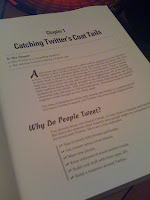
Chapter 1

Twurn the page.
I got through chapter one of the book today; no real accomplishment since that consisted of a whopping seven pages about the basics of Twitter. At least I haven’t quit in frustration yet, right?

As I inch farther into the book, I have a couple of concerns: the Twitter landscape is changing faster than the finality of a printed book will be able to convey, and the chief focus of the teachings may turn out to be making money off of the Twitter API, which is a tangental concern, at best, for me.

I just want to learn enough about the API to be able to talk to users and developers in an informed, interested, and engaged manner, and relate to the same concerns and quandries I might stumble upon during my use.

My final product idea is still very simple, little more than an attempt at a “Hello world,” but with a little something specific to my quest for Twitter employment. But the more that I bang away on this keyboard, the fewer of Dusty Reagan’s pages get read. So, see you on the ‘morrow, on the Web.

01 December 2010

Getting Started

Working from home.
I’ve had many blogs; created and destroyed. This one has been created and will live on until I get a new job. I’m hoping to document some career development during this down time, specifically learning the Twitter API in order to learn more about it, and build some thing off of it.

In an effort towards full disclosure, however, this overtly public attempt to learn a new skill is a blatant attempt to join the flock (translation: land a job at Twitter). The plan is that knowing more about the behind-the-scenes cogs, gears, and mechanics of Twitter will make me a more attractive candidate for Twitter in general, and Sean Garrett and the Twitter Communications Team specifically.

To start this process, I purchased the Twitter Applications Development for Dummies book. However, I know almost nothing about programming, and, being a recovering journalist, marketing writer, and social media manager, I’m sure that I’ll need a lot more than just one book to make something productive with their API. I have a few ideas about an app for the end result, but depending on the hurdles I encounter, I may have to adjust it as the learning process progresses.

So, welcome to the inaugural post. If you work at Twitter—or have worked with the Twitter API—and have any helpful suggestions, I’d love any advice you have to offer. I hope to post something every day, so, see you on the ‘morrow, on the Web.